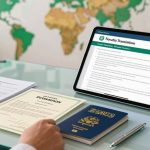
At Novatia Translations, we ensure official documents for Saudi visa applications are translated with precision and full compliance. We verify names, dates, issuing authorities, and alignment across originals and translations, preserving original meaning and proper formatting. We use recognized certifiers, provide attestations as required, and coordinate notarization or apostille when applicable. We tailor timelines to embassy windows and maintain audit trails for authenticity. If you continue, you’ll learn how to meet every requirement efficiently and securely.
Use official translations into accepted languages (primarily English) with exact content and verified terminology; Arabic may be requested by some consulates.
Present translations alongside originals with clear labeling and standardized formatting suitable for Saudi review.
Ensure document integrity: verify names, dates, issuing authorities; align birth and personal details across all papers.
Obtain appropriate authentication: certified translators or authorized bodies, with notarization or apostille where required.
Maintain audit-ready documentation: version control, attestation details, and cross-checks against official templates and signer credentials.
What Documents Must Be Translated for Saudi Visa Applications
Determining which documents must be translated for Saudi visa applications guarantees compliance from the outset. We, as your translation partner, identify core material requiring translation to avoid delays and omissions. Primary documents typically include passports, birth certificates, marriage certificates, police clearance, educational diplomas, and employment letters. Supporting records, such as visas, residency permits, and previous travel histories, may also require translation depending on consulate guidelines. We ensure accurate translation workflow practices so each item preserves original meaning, nuances, and legal intent. Document formatting is essential; we standardize layouts, margins, and typography to align with submission requirements. Our approach minimizes rework by delivering complete, compliant translations in a consistent, easily verifiable format. Trust our precision-focused process to streamline your Saudi visa documentation.
Which Languages Are Accepted for Translations
Choosing the right languages for translation is the next step after identifying which documents must be translated. We set clear expectations about accepted languages to ensure compliance and avoid delays. For Saudi visa applications, translations are typically required into official, widely recognized languages, primarily English. We avoid unnecessary exceptions and ensure that any translated document is accurate, complete, and verifiable. Our policy emphasizes that translations should reflect the content exactly, with faithful terminology and formatting. Irrelevance and irrelevant topic discussions must be excluded from certified translations. We recognize that some consulates may request Arabic as an accompanying language, but we focus on the stipulated standard languages accepted by the reviewing authorities. This approach minimizes risk, clarifies expectations, and supports a smooth submission process.
Who Can Certify and Authenticate Translations
We must establish who is authorized to certify and attest translations and what authentication steps are required. We’ll outline the criteria for acceptable certifiers and the specific authentication procedures to ensure compliance. Please review the designated roles and processes to ensure every document meets Saudi Arabia Visa requirements.
Authorized Certifiers and Attestations
Authorized certifiers and attestations must come from recognized authorities or professionals qualified to certify translations for Saudi Arabia visa applications. We present strict criteria to ensure reliability and compliance, avoiding unnecessary deviation. Our guidance focuses on legitimacy, traceability, and verifiable credentials, while steering clear of unrelated topic tangents and random discussion that could undermine accuracy. To aid clarity, we outline essential certifier categories and attestation practices below:
Official translators or certification bodies recognized by government or embassy authorities.
Notaries or equivalent public officers with authority to attest translations and signatures.
Accredited language professionals with demonstrable experience and appropriate certifications.
We emphasize verifiable contact details, document stamps, and date-stamped attestations to preserve integrity throughout the visa process. Always verify alignment with current Saudi requirements before submission.
Translation Authentication Requirements
Are you sure who can certify and authenticate translations for Saudi Arabia visa applications? We, as your guidance partner, outline Translation Authentication Requirements with precision and compliance. Certifiers must possess formal authority relevant to the document’s origin, and authenticators should verify signatures, stamps, and seals to confirm accuracy and jurisdictional validity. We distinguish between sworn translators, notaries, and embassy-affiliated staff, noting linguistic expertise alone is insufficient without proper credentials. All translations require clear provenance, legible reproductions, and accompanying attestations that align with Saudi and home-country legal frameworks. We avoid unrelated topics and random ideas; instead, we emphasize documented processes, timeliness, and traceable chain of custody. By adhering to these standards, applicants reduce risk of rejection and ensure seamless visa processing.
Is Notarization Required for Saudi Translations?
We clarify whether notarization is required for Saudi translations and outline the related certification standards. We will explain the necessity of translation certification, and detail apostille and attestation steps where applicable. This will guide readers through compliant practices for official documents.
Notarization Necessity Clarified
Notarization requirements for Saudi translations can be unclear; so, we want to clarify how they apply to visa applications. We, therefore, explain that notarization necessity varies by document type and issuing country, not by the visa itself, and that accuracy remains paramount. In practice, you should review whether your home country requires notarization or offers translation authentication as an alternative. Our guidance centers on official norms: when a document is intended for Saudi authorities, notarization may establish legitimacy, while translation authentication confirms linguistic fidelity. We provide a concise checklist to help you prepare.
1) Always verify local notary or consulate rules for notarization necessity before submission.
2) Distinguish between notarization and translation authentication to avoid delays.
3) Seek confirmation from the receiving Saudi authority on acceptable proof of authenticity.
Translation Certification Requirements
Translation certification for Saudi documents hinges on the issuing country’s rules and the document’s purpose; consequently, notarization may or may not be required, depending on the specific document and its intended Saudi authority. We, as translators and consultants, provide clear guidance on when certification suffices and when additional legal apostilles are advisable. Our approach emphasizes compliance and traceability, ensuring that certified translations align with Saudi immigration, consular, and governmental expectations. In practice, officials often accept certified translations issued by recognized authorities, provided the certificate states accuracy and completeness. We also consider institutional preferences that affect processing time and reliability. This focus supports safer navigation for applicants and audience targeting for institutions, by reducing misinterpretation and delays in visa documentation workflows.
Apostille And Attestation Steps
Apostille and attestation steps are essential to ensure Saudi translations are legally recognized across authorities; is notarization always required in this process? We address the procedure with precision, clarifying that translations often require independent attestation rather than automatic notarization, depending on local and Saudi requirements. Our guidance prioritizes compliance, document integrity, and timely submission. We consider travel etiquette and cuisine trends as contextual factors shaping document handling timelines and consular expectations. We provide concrete steps to minimize delays and ensure acceptance by authorities.
Verify whether notarization is mandated by the issuing jurisdiction or Saudi agency.
Obtain the appropriate apostille or embassy attestation before submission.
Include a certified translation and supporting affidavits to satisfy review criteria.
How to Prepare Birth, Marriage, and Police Clearance Certificates for Translation
Preparing birth, marriage, and police clearance certificates for translation requires careful attention to document integrity, legibility, and the specific requirements of Saudi visa translators. We outline practical steps to ensure compliance while preserving original meaning. We verify full names, dates, and issuing authorities on every certificate, and we confirm consistent spelling across all accompanying documents. We ensure that birth registration details align with applicant identifiers, avoiding discrepancies that could delay processing. For marriage registration, we confirm date formats, witness information, and official seals are present, with translations matched to the bilingual certificate. We present clear, bolded headings and attach certified copies as required. We avoid amendments or paraphrasing to maintain authenticity, and we implement standardized formatting suitable for Saudi reviewer review.
Addressing Civil Documents: Titles, Stamps, and Format Requirements
Addressing civil documents requires attention to how titles, stamps, and formats appear on originals and translations. We outline key considerations to ensure admissibility and consistency across documents we handle for you.
Titles and stamps must match the original exactly, preserving case, spacing, and seal impressions where applicable.
Format alignment should reflect official layouts, with legible translations placed alongside originals and clearly labeled notes when deviations occur.
Consistent translation timing and documentation, including version control and revision dates, to preserve language accuracy throughout the process.
How to Handle Translations of Names and Personal Details Accurately
We must ensure name precision and personal details accuracy across all translations to meet Saudi visa requirements. We will outline strict practices for reproducing names exactly as in originals, and for validating variants and spellings with authoritative sources. Our aim is clear, compliant translations that prevent misidentification and support reliable processing.
Name Precision Practices
Ensuring accuracy in names and personal details is essential for visa document translation, as even minor discrepancies can delay processing or trigger requests for clarification. We outline name precision practices to support compliant outcomes and consistent translation timelines.
We verify official spellings from identity documents, ensuring they align with passport nomenclature and local conventions.
We standardize diacritical marks and transliterations only when supported by official guidance, preventing ambiguity across jurisdictions.
We document any name variants, sources, and rationale to aid adjudicators and preserve audit trails within translation timelines.
Personal Details Accuracy
Accurate personal details matter because even small errors can delay visa processing or trigger requests for clarification. We approach personal details with strict consistency, ensuring names, dates, and identifiers align across all documents. Our method emphasizes faithful transliteration, standardized spelling, and careful cross-checks against source materials to prevent misinterpretation. We implement accuracy checks at every stage, validating that each field matches official records and that diacritical marks are preserved when required. When discrepancies arise, we document them and resolve them before submission, avoiding delays. We also prioritize rumor avoidance by relying on verifiable information rather than unverified claims. Readers receive clear instructions on translating and formatting personal data, with our safeguards designed to sustain compliance, reduce ambiguity, and support a smooth visa application process.
Common Pitfalls That Slow Down Visa Processing and How to Avoid Them
Common pitfalls can considerably delay visa processing, so understanding and avoiding them is essential for a smooth submission. We, as your translation partner, outline concrete missteps and corrective actions to align with Saudi authorities’ expectations. By maintaining precise language, proper formatting, and complete supporting documents, we reduce review cycles and rework. While we focus on submission quality, we acknowledge that unrelated topic discussions should not influence the decision, keeping the process objective.
Incomplete form data or mismatched personal details across documents.
Ambiguous or inaccurate translations that fail to reflect originals.
Missing legalization, stamping, or apostille requirements, causing delays.
Avoid these by conducting a pre-submission checklist, cross-verifying every item, and aligning with official guidelines.
Steps to Validate Translated Documents With Saudi Authorities
What steps ensure that translated documents meet Saudi authorities’ validation standards? We guide you through verification by aligning translations with official templates, stamping, and signer attestations, then confirming consistency with source documents. We collaborate with certified translators to ensure terminologies reflect Saudi requirements, and we document each validation step for auditability. We also verify notary and apostille compliance, including accurate notary fees disclosures and apostille timelines, so processing remains uninterrupted. To illustrate how the workflow supports compliance, consider the table below.
Step
Responsible Party
Outcome
Document assessment
Client/Translator
Compliance gaps identified
Translation audit
Certified translator
Terminology accuracy secured
Notarization and apostille
Notary/Authorized body
Legal authentication complete
Final review
Compliance team
Ready for submission
Timelines and When to Start Translations During Visa Planning
Timing is critical in visa planning, so we start translations early enough to align with embassy processing windows and document validation timelines. We coordinate milestones to prevent delays and ensure accuracy across all submissions. Early activity reduces risk of last‑minute revisions and supports predictable adjudication timelines for applicants and sponsors alike. Our approach emphasizes documented schedules, clearance checkpoints, and harmonized timelines with Saudi authorities to maintain compliance.
Establish initial translation timelines aligned to visa application windows.
Set internal review and validation milestones to avoid rework.
Monitor embassy updates and adjust the plan proactively to maintain flow.
No relevance, unrelated topics. This schedule-driven method keeps applicants informed, compliant, and prepared for timely submission.
Cost Considerations: Budgeting for Official Translations
How can we manage costs effectively when budgeting for official translations? We approach budgeting with a disciplined framework, evaluating requirements, timelines, and deliverables to prevent unnecessary expenditures. We start by clarifying the scope: which documents require official translation, certified copies, and accompanying attestations. We then establish acceptance criteria and standard turnaround times, aligning fees with project milestones. We caution against budgeting mistakes that arise from assumed rates, rush orders, or extraneous optional services. Our process includes a vendor comparison to identify qualified providers who meet regulatory standards and maintain audit trails. We document all cost components, from translation to notarization and apostille where applicable, ensuring transparent invoicing. This approach supports compliant, cost-conscious planning without compromising accuracy or compliance.
Where to Find Reliable Translation Services for Saudi Visa Applications
Finding reliable translation services for Saudi visa applications requires a targeted approach. We guide you to evaluate providers that specialize in official document translation, certification workflows, and Saudi Ministry of Foreign Affairs compliance. Our focus remains on accuracy, timeliness, and security, avoiding irrelevant topic distractions or unrelated discussion.
We propose three considerations:
1) Certification and Apostille capabilities, ensuring alignment with Saudi requirements.
2) Dossier experience with visa types, turnaround times, and quality assurances.
3) Transparent pricing, service level agreements, and data protection compliance.
Frequently Asked Questions
Do Translations Need Official Stamps or Seals by the Translator?
Yes, translator stamping is required to ensure seal authenticity; we verify and affix an official seal. We confirm compliance, guarantee traceability, and provide documentation showing seal authenticity for each translated document and its translator’s certification.
Can Translations Be Submitted in Digital Format for Visas?
Yes, digital submissions are allowed for visas. We will ensure compliance with online submission requirements, verify file formats, and maintain accuracy, timeliness, and secure transmission for all digital submissions.
Are Translations Valid if Performed Outside Saudi Arabia?
Translations performed outside Saudi Arabia may be accepted if they meet translation authenticity standards and are accompanied by proper affidavits or certification as required; we advise verifying specific consulate guidelines for outside country translation submissions.
How Are Name Spellings Verified Across Documents?
We verify name spellings through rigorous document matching and cross-checking across all records for consistency, ensuring name spellings verification aligns with official data. Our process maintains compliance, accuracy, and traceability in every submission to you.
Do Translations Require a Specific Font or Font Size?
Yes—we require font compliance and consistent translation formatting; there’s no universal font mandate, but we standardize legibility and alignment with official documents. We ensure our fonts and sizes meet client and consular guidelines, maintaining precise formatting throughout.